

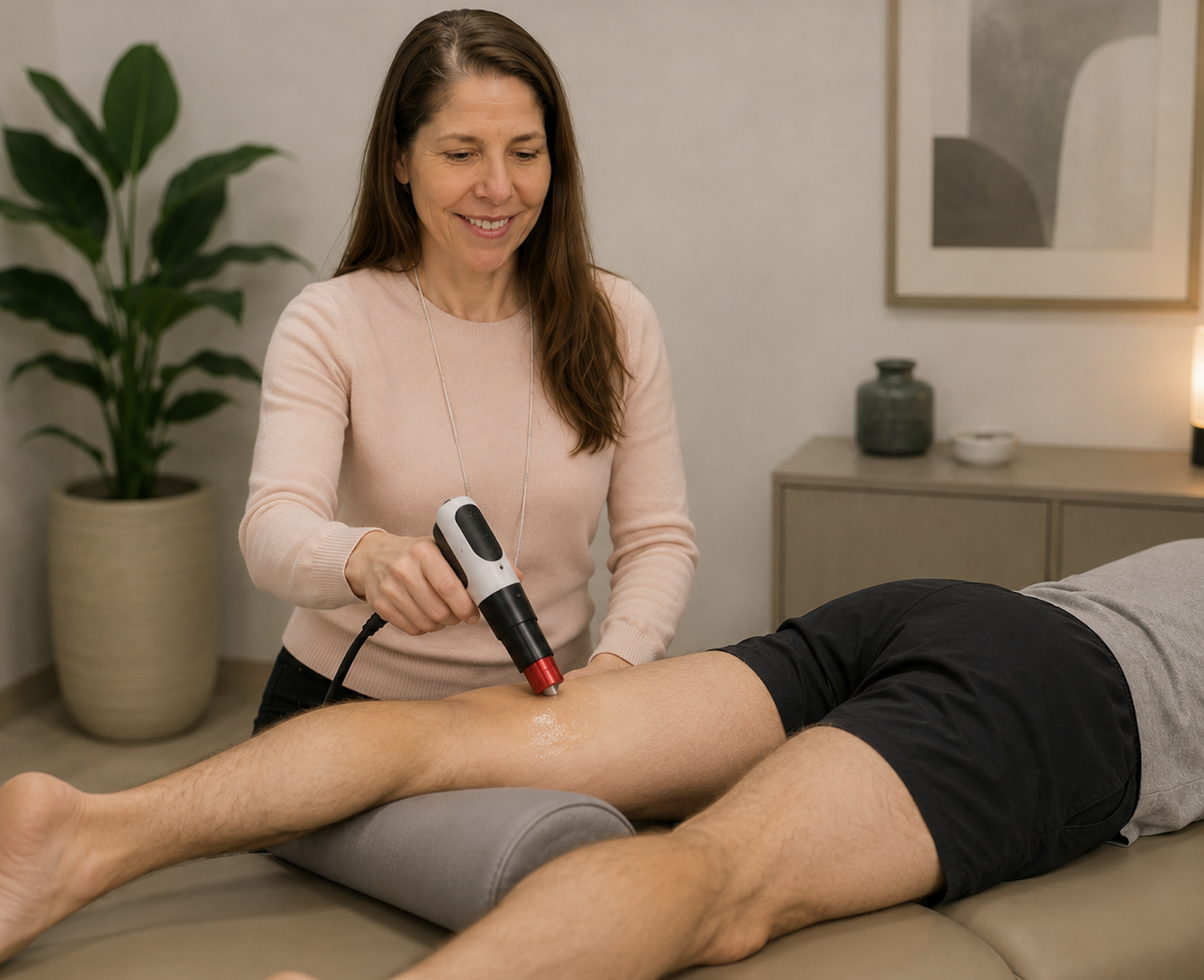
Shockwave
I have been using Shockwave Therapy for over 15 years, long before it became widely available in many clinics today.
Shockwave is a powerful technology designed to stimulate biological healing responses within injured, restricted, or chronically painful tissues. It can be highly effective for tendon injuries, scar tissue, chronic pain, calcifications, fascial restrictions, and areas that have stopped responding to traditional treatment approaches.
What makes my approach different is that I do not view Shockwave as a stand-alone treatment.
In my experience, tissues do not exist in isolation. Chronic pain is often influenced by compensation patterns, nervous system guarding, joint restrictions, fascial tension, inflammation, and altered movement patterns that have developed over many years.
Shockwave is designed to create a biological effect within tissues. It is not designed to overcome nervous system protection patterns on its own.
For this reason, I integrate shockwave into a larger treatment approach that includes osteopathic assessment, myofascial remodeling, nervous system regulation, and hands-on manual therapy. By preparing the tissues before treatment and addressing the underlying restrictions that contribute to pain, shockwave can often be applied more effectively and comfortably.
Every treatment is different. The assessment is always the same.
My goal is not simply to treat where it hurts, but to understand why the tissue stopped responding in the first place and create the conditions for healing to occur.
Shockwave is one of many tools I use to help restore mobility, reduce pain, improve tissue quality, and support long-term recovery.
Common Questions and Concerns
Will Shockwave Therapy Hurt?
This is one of the most common questions I receive.
The answer is: not necessarily.
Many people assume shockwave therapy needs to be painful to be effective. In my experience, this simply isn't true.
I begin by assessing the tissues and preparing the area before applying shockwave. Treatment can be adjusted using different applicators, settings, and treatment depths based on your comfort level and individual needs.
Some areas may be more sensitive than others, particularly when treating long-standing injuries, tendon problems, or chronic pain patterns. However, treatment should always remain within a comfortable and manageable range.
My goal is not to force the body through pain. My goal is to create the conditions for healing.
By combining shockwave therapy with osteopathic assessment, myofascial remodelling, and nervous system regulation, treatments are often more comfortable and more effective than shockwave used on its own.
It does not have to hurt to create meaningful change.
How much do you charge?
My treatment fees are based on the time, assessment, and clinical expertise required to support your recovery—not on the specific techniques used during your session.
Many clinics charge additional fees for specialized therapies such as Shockwave Therapy. I take a different approach.
Over the past 30 years, I have integrated a wide range of treatment methods into one cohesive system. Whether your treatment includes shockwave therapy, myofascial remodelling, cranial sacral therapy, visceral manipulation, nervous system regulation, osteopathic techniques, or manual therapy, the goal remains the same: helping your body move, heal, and function more effectively.
I do not charge extra for the tools I use. I choose the techniques that best support your needs during each session.
Every treatment is different. The assessment is always the same.
30 Minutes: $97.35 plus HST=$110.00
45 Minutes: $115.04 plus HST=$130.00
60 Minutes: $132.74 plus HST =$150.00
Your treatment will be customized based on your goals, your body's response, and the clinical findings from your assessment.
Low Level Laser Therapy
Low Level Laser Therapy (LLLT), also known as photobiomodulation, uses specific wavelengths of light to stimulate cellular activity and support the body's natural healing processes.
When absorbed by the tissues, light energy is utilized by the mitochondria—the energy-producing structures within our cells. This process helps increase ATP production, often referred to as the body's cellular energy source. Increased ATP production can support tissue repair, reduce inflammation, improve circulation, and accelerate recovery.
Laser therapy can be beneficial for a wide range of conditions, including chronic pain, arthritis, tendon injuries, muscle strains, inflammation, post-surgical recovery, nerve irritation, and tissue healing.
While the technology itself is powerful, successful treatment depends on more than simply applying a laser to a painful area.
Pain is not always caused in the area that you are hurting.
30 years of clinical practice have taught me that successful outcomes often depend on identifying the tissues, joints, compensation patterns, and nervous system responses contributing to the problem. Treating the wrong location—or treating symptoms without understanding the underlying cause—may produce little change.
This is why laser therapy is incorporated into a comprehensive assessment and treatment approach rather than being offered as a stand-alone service.
Every treatment is different. The assessment is always the same.
My goal is to identify the tissues limiting recovery and to use the appropriate combination of therapies to create the best environment for healing.
Laser therapy is one of many tools I use to help reduce inflammation, support tissue repair, improve function, and accelerate recovery.